Goat Milk vs. Cow Milk Formula
🎧 Podcast Version: “From the Files of Dr. Marie…”
📖 Read the Text Version
During the height of COVID, when the world felt fragile and supply chains felt even more so, my phone rang from Paris.
It was my sister, Nadine.
Her voice carried that tone I know too well — the tightness of a new mother who has run into uncertainty. There was a shortage of baby formula. Shelves were thinning. Anxiety was thick. And she wanted to know:
“Marie… is goat milk okay for my baby?”
In that moment, I was both pediatrician and sister. And I’ll tell you something honestly — at that time, I knew very little about the latest research on goat milk–based formula. Which often put me in the same place as many parents: searching for clarity in a sea of half-answers.
When families don’t know, they call us. And sometimes, we are still learning too.
So I went back to the science.
Why Goat Milk Entered the Conversation
Many American clinicians first became more aware of goat milk–based formulas during the 2022 formula shortage, when imported products began appearing on shelves . Regulators reassured families that these formulas had established safety and nutritional adequacy in Europe and other countries .
But reassurance is not explanation.
The real question parents ask is deeper: Does the dairy base — goat versus cow — actually matter? Researchers in Europe are currently investigating exactly that. A large trial of approximately 2,000 infants is evaluating whether cow milk or goat milk in formula influences the risk of developing atopic dermatitis.
The study is called the “Goat Infant Formula Feeding and Eczema (GIraFFE) Study”, a double-blind, randomized controlled trial examining whether whole goat milk formula supports normal growth and affects eczema risk .
When my sister called, this study was already underway. But like many parents, she needed an answer now.
The Protein Differences — And Why They Matter
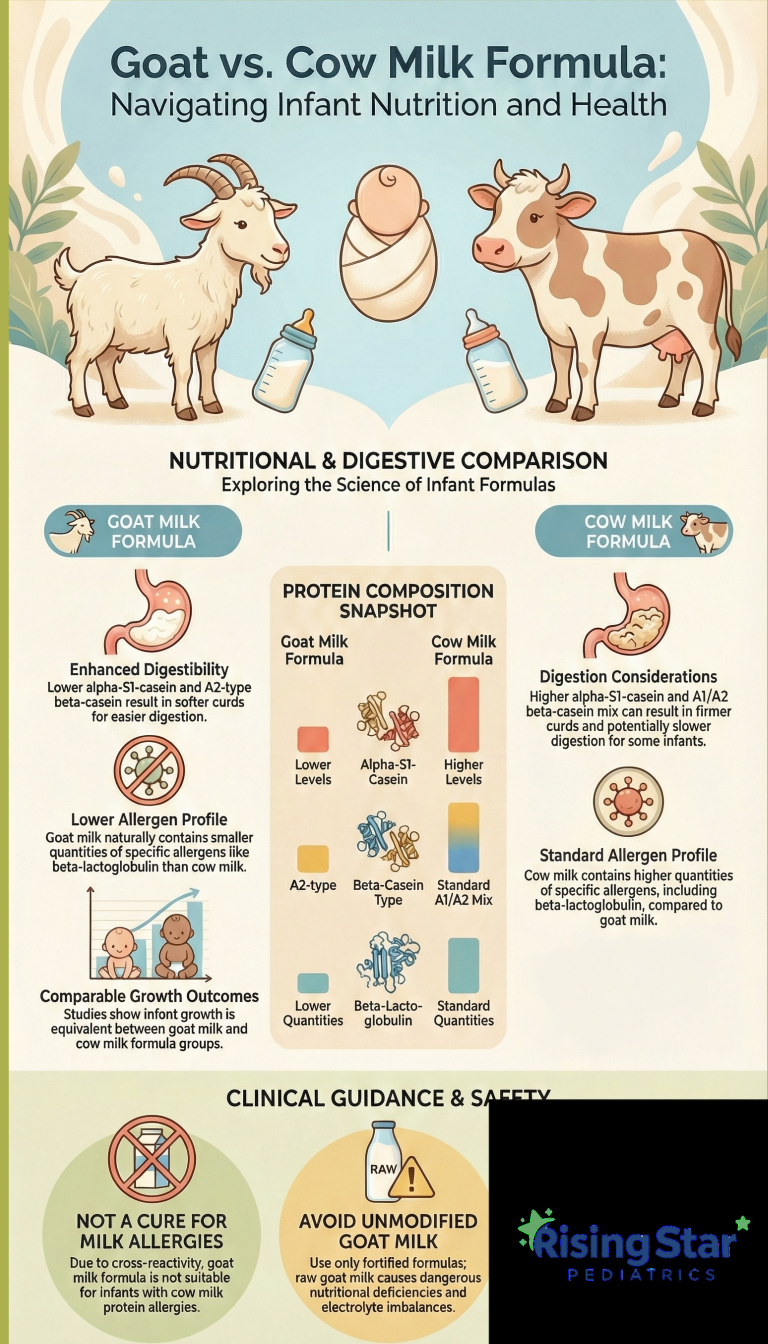
Milk proteins are not identical across species. Compared to cow’s milk, goat milk naturally contains:
- Less alpha-S1-casein
- Only A2-type beta-casein
- Lower levels of beta-lactoglobulin, a known allergen in cow milk
Why does that matter?
Milk contains two major protein families: **casein** and **whey protein**. Casein forms a curd in the stomach during digestion. The type of casein influences how firm or soft that curd becomes.
Goat milk’s lower alpha-S1-casein and exclusive A2-type beta-casein profile may contribute to softer curd formation in the stomach and potentially better digestibility .
Beta-lactoglobulin, a whey protein present in lower amounts in goat milk, is one of the major allergens in cow milk .
Biologically, these differences are meaningful. Clinically, we are still determining how meaningful.
That distinction matters.
What the GIraFFE Study Is Showing So Far
Preliminary data presented at the European Academy of Paediatrics 2025 indicate that growth outcomes were comparable between infants fed goat milk formula and those fed cow milk formula .
That is non-negotiable territory. If a formula does not support normal weight gain, length growth, and head circumference development, it does not belong in the conversation.
Researchers have also reported “interesting signals” regarding allergy-related outcomes, particularly the incidence of eczema . Full peer-reviewed results are forthcoming.
Signals are not conclusions. They are directions for further study.
As a physician, I am trained to live inside that restraint.
What I Told My Sister
I told Nadine this:
First, we are talking about **properly fortified and processed infant formula**, not plain goat milk.
Unmodified goat milk can cause **nutritional deficiencies** and **electrolyte imbalances** in infants . It is not safe as a direct substitute for formula.
Second, goat milk formula is not a treatment for cow milk protein allergy (CMPA). Despite protein differences, cross-reactivity between cow and goat milk proteins has been demonstrated . If a child has true CMPA, their immune system may still react to goat milk proteins.
Third — and I say this always — **breastmilk remains the gold standard** . Formula is intended for situations where breastfeeding is not possible, insufficient, or not chosen .
But when formula is needed, it must provide safe, complete, and well-tolerated nutrition during a critical window of infant growth and immune development .
And based on the evidence available, goat milk–based formula met those standards.
So I told her: “Yes. A regulated goat milk formula is a reasonable option.” Not magical. Not superior. Reasonable.
Sometimes that is what reassurance truly is.
The Deeper Lesson
COVID forced many of us into uncomfortable spaces of uncertainty. As physicians, we were reading data in real time. As mothers and sisters and daughters, we were living the consequences of shortages and fear.
When Nadine called, I felt the weight of that dual identity. I had the training — but I also had limits. And perhaps that humility is part of good medicine.
Parents often imagine that pediatricians possess a vault of final answers. The truth is more dynamic. We have frameworks. We have evolving evidence. We have clinical judgment shaped by training and experience.
And we have the responsibility to say when data are still emerging.
Right now, here is what we know:
- Goat milk formula supports normal infant growth comparably to cow milk formula .
- Its protein composition differs in ways that may influence digestibility.
- Research is ongoing regarding eczema and allergy outcomes.
- It is not appropriate for infants with confirmed cow milk protein allergy.
- Unmodified goat milk is unsafe for infants.
When families ask whether goat milk formula is “better,” I resist that framing. Better depends on context. For some infants, it may be well tolerated. For others, cow milk formula works beautifully.
The goal is not novelty. The goal is nourishment.
For Parents Standing in the Formula Aisle
If you are reading labels and wondering what to choose, remember this: Your baby does not need perfection. They need adequacy, safety, and love. If your child is growing well and tolerating their formula, that is success.
If you are navigating shortages or considering options within regulated formulas, goat milk–based formula is supported by current safety data and emerging research.
And if you ever feel uncertain, reach out. Ask questions. Medicine is not a solo journey.
When my sister called from Paris, she needed reassurance more than a lecture. She needed to know that science had not abandoned her.
It had not. It rarely does.
As both a pediatrician and a mother, I have learned this: science evolves, but the commitment to protect our children remains constant.